Why I Taught My AI Pipeline to Stay Silent
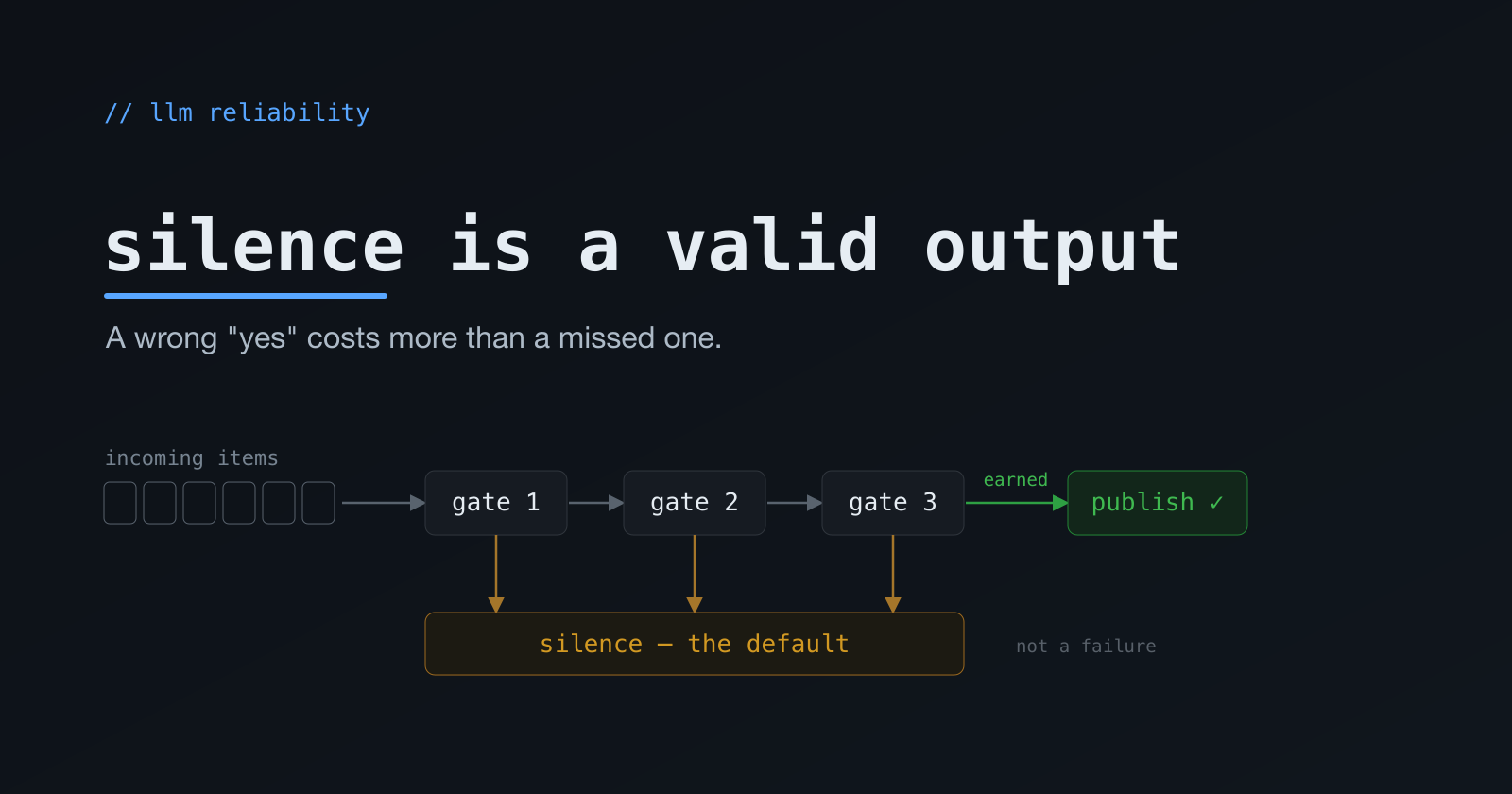
There’s a version of “reliable AI” that everyone talks about, and a quieter one that actually ships. The loud one is about making the model right more often. The quiet one is about deciding what happens when it isn’t — and building the whole system around that answer instead of the accuracy number.
I ended up on the quiet side by accident, running a pipeline that reads a stream of financial news and forwards only the items that matter. And the thing that taught me the lesson wasn’t a paper or a framework. It was watching what a wrong answer actually costs.
The asymmetry nobody prices in
When you build a classifier, the default mental model is a confusion matrix where a false positive and a false negative are two kinds of “oops.” Precision here, recall there, tune to taste.
But those two mistakes are almost never equal in the real world, and for a system whose entire job is to decide what’s worth trusting, they’re wildly unequal.
Miss a real story? Someone reads it somewhere else a few minutes later. The cost is a small delay.
Forward a wrong one? Someone acts on it — precisely because your system was supposed to have caught it. The whole point of a filter is that passing through means something. Every false positive quietly devalues every true one that came before it. You’re not just wrong once; you’re eroding the reason anyone trusts the pipeline at all.
Once I saw it that way, “high accuracy” stopped being the goal. The goal became: make a pass-through trustworthy, even if that means staying silent more often than a balanced model would. I was willing to trade recall. I was not willing to trade trust.
Silence as a design decision, not a failure
This is where it gets a little philosophical, and I think that’s the part the current wave of “AI reliability” content mostly skips.
We’ve trained ourselves — and our models — to treat an answer as the deliverable. Ask a question, get a response. A model that says “I’m not sure” feels like a broken model. So we force binaries, we lower thresholds, we accept the confident-but-wrong because at least it answered.
Last month, curl paused security reports for a stretch because the queue had filled with exactly this: AI-generated bug reports, confident, plausible, and wrong. It’s the same failure the Stack Overflow survey named — the top frustration with AI isn’t uselessness, it’s being almost right. The industry is drowning in answers nobody asked to be trusted.
So I inverted the default. In my pipeline, “I’m not sure” doesn’t mean broken. It means stay silent, and silence is a valid, often correct, output. A model that abstains isn’t failing to do its job; on a borderline case, abstaining is the job. The system’s default state is quiet, and speaking up is what has to be earned — by clearing every gate, not just the last one.
That reframing changed more than the code. It changed what I considered a good day for the system. A good day isn’t “we forwarded a lot.” It’s “everything we forwarded was worth forwarding, and the things we weren’t sure about, we let pass by.”
The uncomfortable part: you can’t feel this working
Here’s the catch, and it’s why most people don’t build this way. A system tuned to stay silent is, by design, quiet. And quiet-because-it’s-careful looks identical to quiet-because-it’s-broken. You cannot tell them apart by watching.
That’s the real reason the discipline matters — not as engineering hygiene, but as the only way to know your caution is caution and not just failure wearing its clothes. I keep a labeled set of the hard cases — the almost-right, the plausible-but-stale — and every change gets measured against it, with the one number I actually care about held as a hard line. (I wrote up the mechanics of that harness separately, for anyone who wants the how rather than the why.)
But the mechanics aren’t the lesson. The lesson is the mindset shift that came first: deciding, before writing a line, that a wrong “yes” costs more than a missed “yes,” and letting that single decision reshape everything downstream — the thresholds, the gates, the definition of success, even what “the model did well today” means.
Everyone’s racing to make AI answer more. I got more mileage out of teaching mine when to shut up.